


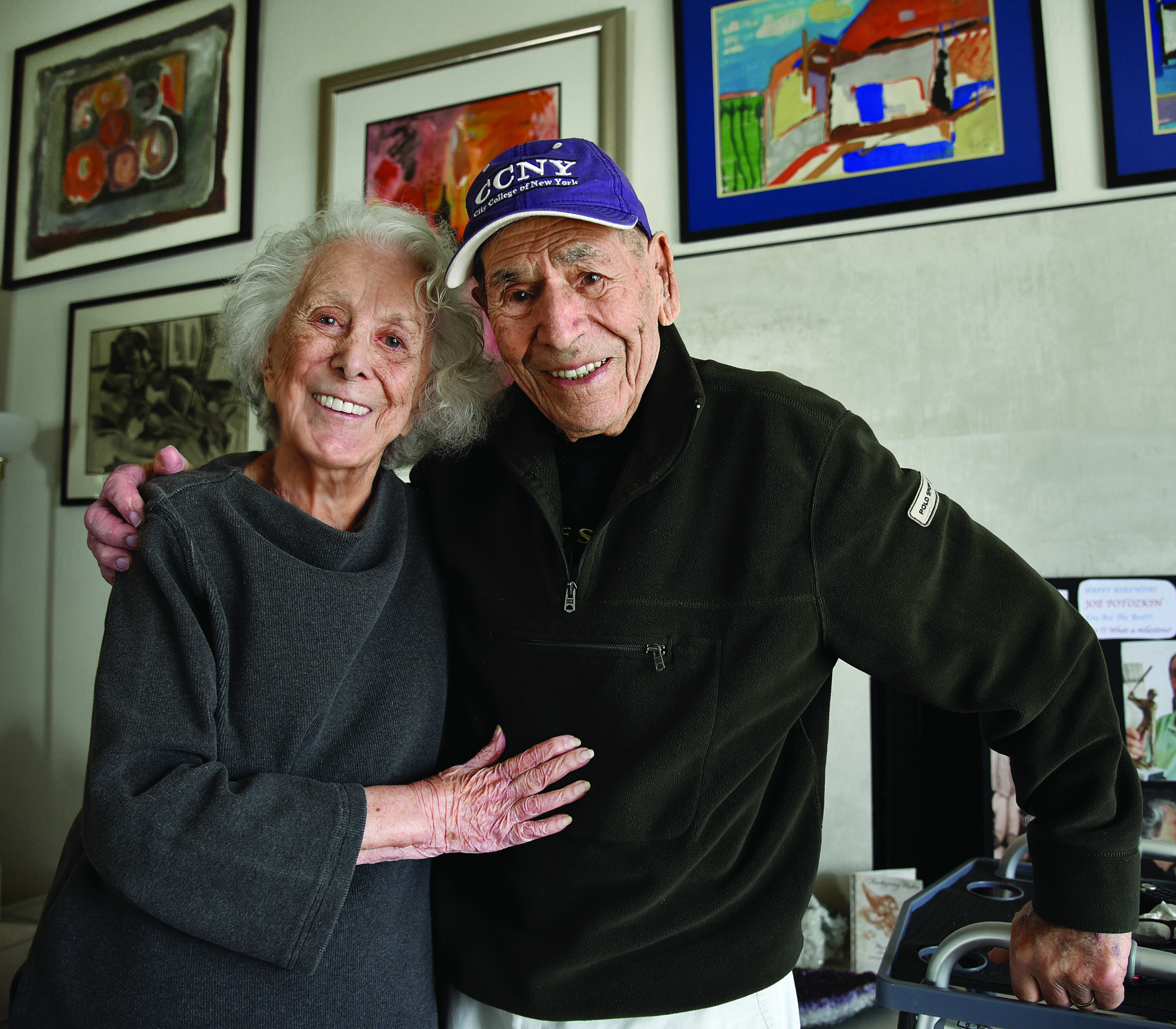
When Joe Potozkin looks back at his 100 years, there’s much on which to reflect.
Potozkin, a World War II U.S. Navy veteran, turned 100 on Jan. 23. Asked about his secret to reaching that magic number, he put it simply.
“Well, it’s not sweating the small stuff,” he said during a recent interview in his Rossmoor home. “I’m a pretty calm guy.”
Among a dwindling number of living veterans of the Second World War, Potozkin also takes heart in his accomplishments in education, youth camps and sports, and respect and praise from those he’s impacted. Along the way, the native New Yorker sparred with Sugar Ray Robinson, joked with Itzhak Perlman, and to this day receives thanks and appreciation from former students and campers.
Having a close-knit family is important. Potozkin and Shonny, his wife of 77 years, have lived in Rossmoor since November 2000. He beams over the successes of their two children – daughter Amy in the theatrical world and son Jerome as a dermatologist. Their two grandsons are in college, one at Chapman University and the other at USC. He values education, where both he and Shonny found their career callings.
Serving his country
Potozkin was born in Harlem and grew up in the Bronx when money was scarce during the Great Depression. At 17, he was eager to sign up to serve this country in World War II. But his father gave him one requirement before signing the paperwork.
“When I brought the papers, he says, ‘Sure, I will sign. But first, finish high school,’” he recalled.
Potozkin graduated, joined the Navy and went to signalman school in Newport, Rhode Island, where he was trained in semaphore and Morse code, used to communicate on the high seas during wartime.
He and others stationed on the U.S.S. Shelby in 1945 sometimes were at sea for 30 days at a stretch without seeing land.
Some of what he did see was horrifying, particularly in Saipan, from the bridge of his ship: “I would watch women holding their babies, jumping off the cliff and committing suicide, because they were told that the American soldiers were going to do horrible things to them,” he said.
Once the island was captured, the opposite was true, he said, noting that Americans fed people and took care of the babies of the Western Pacific island.
The threat of Japanese kamikaze attacks was constant when he was in the midst of the Battle of Okinawa. The 82-day battle claimed more than 200,000 lives, between Allied and Japanese forces and civilians.
“The thing about Okinawa is that you hardly could sleep or eat because every 20 minutes, a number of kamikaze planes were coming down and you’d hear it: ‘Report to your battle stations,’” he said.
During one attack, one such “suicide plane” missed his ship but struck the nearby U.S.S Birmingham. The wounded from that ship and wounded Marines from the shore were taken aboard his ship and brought to a hospital in Saipan.
His ship was in San Francisco when the war ended after the U.S. dropped atomic bombs on Hiroshima and Nagasaki. Thanks to the G.I. Bill of Rights, Potozkin was able to go to college and enrolled at City College of New York, whose ballcap he wore while being interviewed last week.
Working with youth
After earning a bachelor’s and then a master’s degree, he became dean of discipline at a middle school in Brooklyn. That was ironic because he once was the kid finding trouble. “The kids who were sent to me were getting in trouble for the same thing I used to get in trouble,” he said.
He spent 37 years at the school, at times serving as assistant principal and principal. Another role close to his heart was director from 1953 to 1973 of a children’s camp for poor kids. “They came to camp three weeks at a time, and they didn’t have to pay anything.”
The impression he made on so many kids still resonates. One former camper drove 5 ½ hours from Southern California to attend Potozkin’s 100th birthday celebration at Bridges Restaurant in Danville.
“Even on Facebook today, many campers said how I changed their life,” he said.
Indeed, one Facebook post on Potozkin’s milestone earned 82 comments and 194 likes, many using the heart symbol, Shonny said. “That gives you some idea of his influence.”
Among mementos for his 100th birthday was a birthday card packed with wishes from those at his son’s large dermatology practice in Danville.
“He is well-liked wherever he goes, because he’s not trying to prove – or doesn’t try to show he is better than anyone else,” Shonny said.
His calm presence brings out the best in everyone, Shonny said. “He’s just a very evolved human being.” Former campers and counselors credit him for their successes.
“Wherever he goes, there’s good,” she said.
He finds that camp experience in Rossmoor. “It’s like summer camp here,” he said. “It’s a wonderful place. And the people who live right around us are so wonderful. They bring desserts. They bring the soup. Everybody’s bringing stuff to us.”
A magical meeting
When he returned from the war, Potozkin made for a dashing sight dressed in his Navy whites, Shonny said. They connected at a bus stop in 1949 in a scene right out of a movie. Joe saw Shonny waiting for a bus, while he was boarding another.
“I was almost inside the bus, and I turned and saw her, and the door was closing in on me,” he said. “And I squeezed off the bus, and then I went over and said, ‘What are you doing here?’” That meeting lit a spark, Shonny said.
Potozkin excelled in whatever sport he tried. He was leading scorer on his high school basketball team and went on to coach and referee that sport. He was inducted into the Rockland County Hall of Fame due to his talent at fast-pitch softball.
Skilled at tennis, he was a top player for Rossmoor’s men’s club before giving up that sport at 94. He often gave free theater tickets to his tennis teammates, since Amy was casting director at Berkeley Repertory Theater, a position she held for 30 years.
He took up boxing in the Navy, where he won a welterweight championship, and continued in college. There was a chance meeting with Robinson, winner of world championships as a welterweight and middleweight and regarded by many as pound-for-pound boxing’s all-time best.
Potozkin teased Robinson that he was unsure Robinson was truly a world champ since he’d never beat Potozkin. Robinson invited him to spar with him for three rounds at famed Gleason’s Gym in Brooklyn.
“He said I was pretty good, and I should turn professional,” Potozkin said. “And I told him if he had a Jewish mother like I have, he wouldn’t be fighting today.”
He used his wit in another celebrity encounter. Potozkin recalled when Amy was rehearsing with acclaimed violinist Perlman’s daughter, who was crying and needed encouragement.
“My daughter tells her, ‘You know your lines, just get up there and say your lines, it’ll be OK,’” he said.
When the show went on, Perlman’s daughter grew confident and was good, he said. Afterward, he went over to Perlman to tell him how good his daughter was.
“I said, ‘You should be very proud of your daughter. She’s very talented,’” he told Perlman, adding “What do you do? You sing? You dance?’” Perlman replied, “I play the fiddle.”
He told Perlman, “If you practice three hours a day, someday you’ll make it to Carnegie Hall.” Perlman told him, “Thank you, I think I’m going to do that.” He laughs that Perlman, who already was very famous, played along with his joke.
These days, Joe and Shonny spend a lot of time in their Rossmoor home, where their living room is adorned with several of Shonny’s colorful paintings. She has chronic fatigue syndrome, so Joe helps in special ways, including making daily brunch. Amy helps with grocery shopping to ensure they eat healthy, he said.
To mark his 100th birthday, Shonny composed a personal note, partly based on lyrics made famous by Bette Midler. Addressing him as “Yussie” (an affectionate Yiddish nickname), she wrote, “You help me fly higher than an eagle; During my challenging times; for you are the wind beneath my wings.”
After a conversation on his lifetime adventures, Joe calmly went to the kitchen to make Shonny brunch – two eggs (“flip flops,”) coffee and sourdough, with a little bit of orange marmalade.